

What team and budget did it take to automate response aggregation and flash reporting for a major event in 1 month?
Seirai Technologies' dedicated engineers and bilingual PM joined the development team directly and built, in 4 weeks, a pipeline that automatically collects social media, web survey and operations log data and delivers real-time summaries, transforming sponsor reporting that used to take 3 days after an event ended into automatic real-time delivery during the event. It went live in time for the tournament schedule. With a team of 2 engineers and 1 bilingual PM, the work took about 3 person-months; the reference price for an equivalent short-term build with hands-on engineering support is from ¥3 million (excl. tax), and a monthly time-and-materials contract is from ¥1 million per person-month (excl. tax).
Before and after
| Item | Before (manual aggregation after the event) | After (Seirai automated collection and flash-report platform) | Impact |
|---|---|---|---|
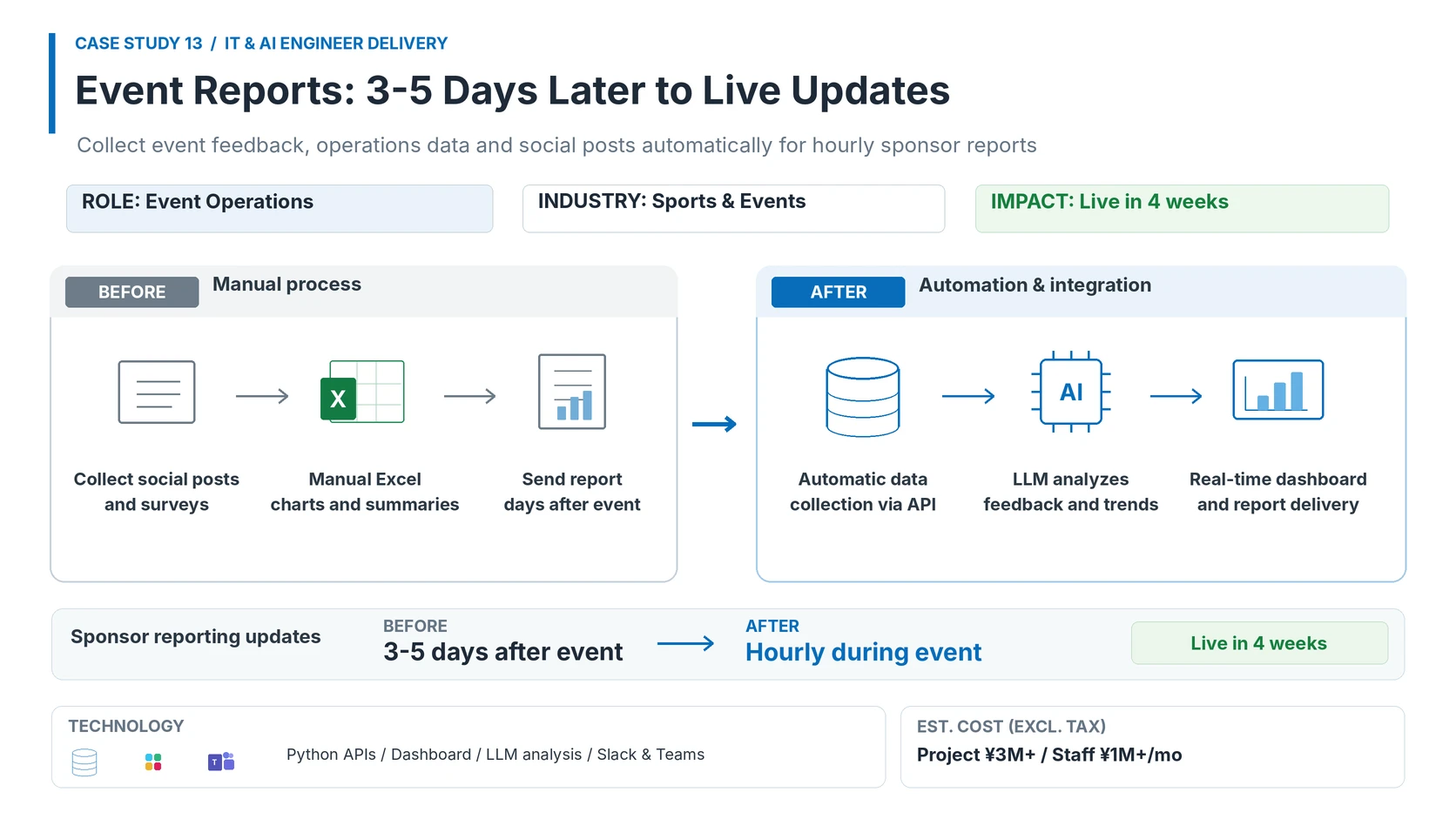
| Submission of flash reports to sponsors | 3–5 business days after the tournament ends | Updated automatically every hour during the event, plus a wrap-up report straight after it ends | Higher sponsor satisfaction and contract renewal rate |
| Aggregation workload on operations staff | Excel charts built by hand late at night and on days off after the event | Fully automated (zero manual aggregation work) | Staff concentrate on operational quality and safety during the event |
| Understanding multilingual (Japanese and English) response | Reactions from overseas spectators and media were not aggregated | Japanese and English posts translated automatically, classified by sentiment and visualized together | Maximizes the PR value of a global event |
| Lead time to build the system | A typical contract-development quote was 3 months, too late for the deadline | Production release in 4 weeks with a direct line to dedicated engineers | Reliably ready for an event date that cannot move |
Challenges before the project
The client, which runs international tournaments and major sports events, wanted to visualize social media response and visitor surveys instantly during events to increase the value of its reporting to sponsor companies, but faced a serious shortage of resources.
Just over a month to the event and no in-house engineers
There were ideas for the plan, but nobody in the company could put together API integration, a data pipeline and AI summarization in one go.
Gave up on a major development company after being told requirements definition alone would take a month
Ordinary waterfall-style contract development would not have been ready for the event date, and the budget was more than double what had been expected.
English comments from overseas spectators and teams were not being analyzed
Although the events were international, only Japanese data could be aggregated, and preparing reports for global sponsors took 3–5 business days every time.
How we solved it: approach and architecture
Cutting out heavy documentation procedures, we completed development in 4 weeks with an agile, hands-on team in which engineers from the University of Tokyo and IIT and a bilingual PM joined the customer's Slack/Teams directly.
Daily development over direct chat, with zero rework
Without waiting for a weekly meeting, specifications were decided on the spot through chat and a working demo every 2 days. The indicators the event operator wanted (positive/negative ratio, detection of words signalling venue congestion, sponsor exposure trends) were implemented as fast as possible.
Real-time collection in Japanese and English, with an AI trend-summary pipeline
We built in Python a back end that automatically collects form responses and public response data from the web and social media, and automatically classifies and summarizes them in both Japanese and English, English posts included.
Alerts for the operations headquarters, plus automatic report output for sponsors
Early signs of trouble at the venue (for example a sudden rise in congestion at the entrance gates) trigger an immediate alert in the operations headquarters' chat, and for sponsors a wrap-up report is generated automatically 15 minutes after the tournament ends.
Workflow and system: before and after
Results after the project
Fully live in 4 weeks from an inquiry made 1 month before the event, with report submission cut from 3 days to straight after the event ends
Flash data could be shared with sponsors at the reception held right after the event, and negotiations on continued sponsorship of the next tournament went smoothly.
Also helped detect trouble at the venue early
Comments on social media and visitor forms, such as crowded toilets or directions that were hard to follow, were detected in real time and staff deployment was improved on the spot.
Voice from the field: “With an event date that absolutely could not move, the reassurance of chatting directly with the engineers and being shown a working screen every week was overwhelming. We could analyze the English data together as well, and got a system that exceeded expectations within budget.” (Staff member, Event Digital Promotion Department)
System stack and environment
| Layer | Technology and configuration |
|---|---|
| Data collection pipeline | Python (automated integration batch for public APIs and survey forms) |
| AI classification and multilingual summarization | LLM sentiment analysis (automatic Japanese–English translation, urgent-word detection) |
| Real-time visualization | Lightweight web dashboard (PC and tablet) |
| Notification and report delivery | Automatic flash notifications in Slack / Microsoft Teams + automatic wrap-up output in PDF/Excel |
| Infrastructure and uptime monitoring | Auto-scaling cloud environment (handles load spikes on the event day) |
| Development and support team | Dedicated Seirai AI engineers + bilingual PM (4-week sprint development) |


Product names and logos shown are trademarks or registered trademarks of their respective owners.
Frequently asked questions
QCan we consult you even if we have no in-house engineers and our requirements are still vague?
Yes. A bilingual PM and engineers work alongside you as one team from putting the requirements into words through prototyping to production, so you can come to us at the idea stage.
QBesides short one-off development, do you offer month-by-month AI engineer support (time-and-materials or lab-style contracts) and talent referral?
Yes. We respond flexibly, not only with fixed-price development by project but also with monthly hands-on support (time-and-materials contracts) and proposals of AI and PM talent that fit your team.
QCan we also leave to you an infrastructure design that withstands the high load (traffic peaks) of the event day alone?
Of course. We design a cost-efficient cloud setup that scales resources up automatically only during the event and returns to a minimum configuration afterward.