


What architecture and budget did it take to build a closed-network RAG and generative AI platform for 500 people in 3 months?
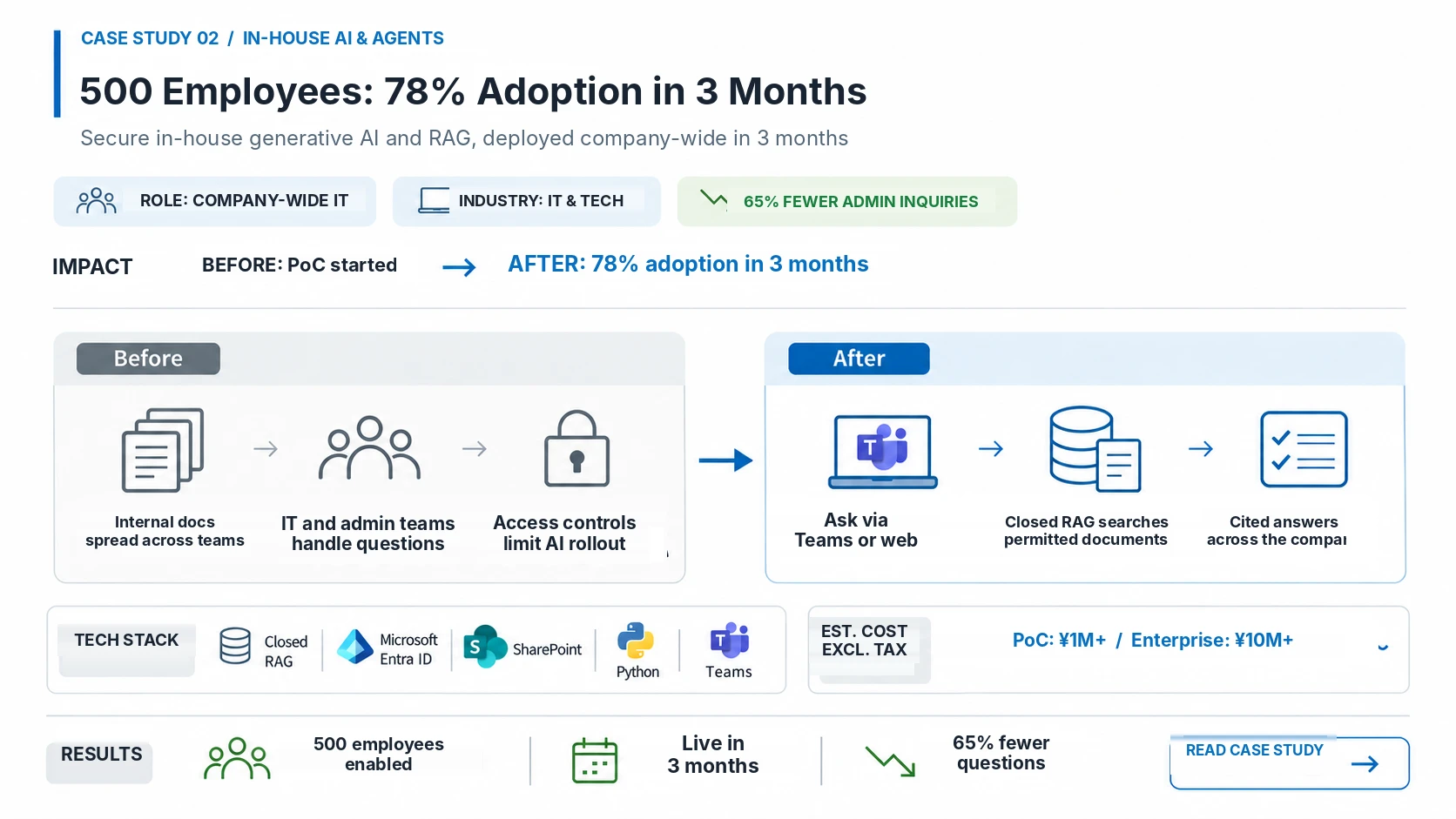
By building, in 3 months, a closed-network RAG (retrieval-augmented generation) platform that inherits the department-level access permissions in Microsoft Entra ID as they are, the client cut the time spent searching for and answering questions about internal rules and past knowledge from an average of 30 minutes to 3. The verification phase was a 3-week PoC. With an assumed team of 1 PM and 3 engineers, the company-wide rollout took about 9–10 person-months; the reference price for an equivalent configuration is from ¥1 million for the paid PoC and from ¥10 million for a company-wide rollout to 500 people (both excl. tax).
Before and after
| Item | Before (folder search and human support) | After (Seirai closed-network RAG platform) | Impact |
|---|---|---|---|
| Time to look up internal rules and specifications | 30 minutes on average (browsing SharePoint folders and asking colleagues) | About 3 minutes (a chat question, with the relevant page quoted) | Research and inquiry effort cut by 90% |
| Risk of leaks and use of data for training | Scattered use of free AI tools on personal accounts | Zero external training on input data; every log available for audit | Company-wide governance established |
| Viewing permissions between departments | Managed by hand, file server by file server | Entra ID integration excludes documents outside a user's permissions from search | Prevents accidental access to executive and HR documents |
| Time to deployment | 8–12 months quoted by a major vendor | Phased rollout to 500 people in 3 months, including the PoC | Development period cut to about one third |
Challenges before the project
The client had more than 12,000 rules, manuals and past proposals stored in SharePoint and on internal file servers, but staff were raising the following issues.
Nobody knew where the latest document was
Every time employees needed to check benefits, expense claims or security requirements they asked General Affairs or IT by chat, and the back-office teams were spending more than 120 hours a month responding.
General AI chat tools could not control viewing permissions
Simply loading every internal document into RAG risked HR evaluation documents or unpublished management-meeting material appearing in ordinary employees' search results, so the company could not commit to adoption.
Concern about AI making things up (hallucination)
An AI answering questions about internal rules by guesswork could cause operational incidents, so a mechanism that always shows the relevant page of the internal document used as the source was a mandatory condition.
How we solved it: approach and architecture
We built a closed-network RAG architecture that connects seamlessly with the client's existing Microsoft 365 environment in three phases: verification, then permissions and data preparation, then company-wide rollout.
Document-level access control linked to Microsoft Entra ID
When a user asks a question, the search is filtered to only the files that user is already permitted to view in SharePoint. Documents outside those permissions are excluded entirely from the context the AI refers to.
Hybrid search that copes with tables and PDF manuals, plus citation links
Rather than plain vector search alone, we introduced hybrid search combined with keyword matching (BM25) and re-ranking. The source file name and page number are added automatically at the end of each answer, so the original can be checked in one click.
Department-by-department onboarding led by a Japanese–English bilingual PM
We tuned answer accuracy every week not only with IT but with representatives of Sales, General Affairs and Development, and shipped prompt templates as standard so that usage would stick.
Workflow and system: before and after
Results after the project
Response time cut from 30 minutes to 3, with 65% fewer questions to the back office
Asking the internal AI first and checking the source document became part of the culture, and routine questions to General Affairs and IT fell to two thirds or less.
Shadow IT (unauthorized use of personal AI tools) eliminated
Providing an official AI environment that every employee can use safely, with caps on monthly pay-as-you-go charges, removed the risk of confidential information being entered into outside services.
78% active usage three months after launch
Because the UI can be called directly from Teams, it spread through an organization of 500 people without special training.
System stack and environment
| Layer | Technology and configuration |
|---|---|
| Front end and UI | Dedicated web chat UI + Microsoft Teams app integration |
| RAG and search engine | Hybrid search (vector search + keyword search) + re-ranking |
| LLM runtime | Closed private environment (opt-out from data training, encrypted communication guaranteed) |
| Authentication and access control | Microsoft Entra ID (SSO + file-level RBAC permissions inherited) |
| Data synchronization pipeline | Automatic incremental index updates from SharePoint and internal file servers |
| Audit and governance | Usage logs for every prompt, cost-cap alerts by department |
Product names and logos shown are trademarks or registered trademarks of their respective owners.
Frequently asked questions
QWhen internal rules are revised, is the AI's knowledge updated automatically?
Yes. When files in SharePoint or the designated folders are updated or added, a nightly batch or a change-detection pipeline re-indexes them automatically, so answers are always based on the latest rules.
QCan a small or mid-sized company with 100 employees or fewer introduce the same system?
Yes. For 50–100 people, a slimmed-down configuration makes it possible to start from a production MVP from ¥3 million (excl. tax; 1–2 months).
QCan it handle English internal manuals and communication with overseas offices?
Yes, Japanese–English bilingual operation is supported. Asking in Japanese and having the system search, translate and summarize global rules written in English is supported as standard.
