

How did a closed-network RAG build cut internal helpdesk responses from 30 minutes to 3, and what did it cost?
By integrating into Microsoft Teams a closed-network RAG chatbot with hybrid search across internal manuals and policy PDFs (about 3,500 files), and building a route that automatically raises a ticket with IT only for unresolved cases, the client cut internal inquiry handling from an average of 30 minutes to 3. The full build followed a 2-week paid PoC, 1.5 months in total. With an assumed team of 1 PM and 2 engineers, main development took about 3 person-months; the reference price for an equivalent configuration is from ¥1 million for the paid PoC and from ¥3 million for the full build (both excl. tax).
Before and after
| Item | Before (direct contact by phone, email and chat) | After (Seirai closed-network RAG helpdesk) | Impact |
|---|---|---|---|
| Resolution time per inquiry | 30 minutes on average (waiting for a reply + finding documents + explaining verbally) | About 3 minutes (a question in Teams, an instant answer with the source PDF) | Resolution 90% faster |
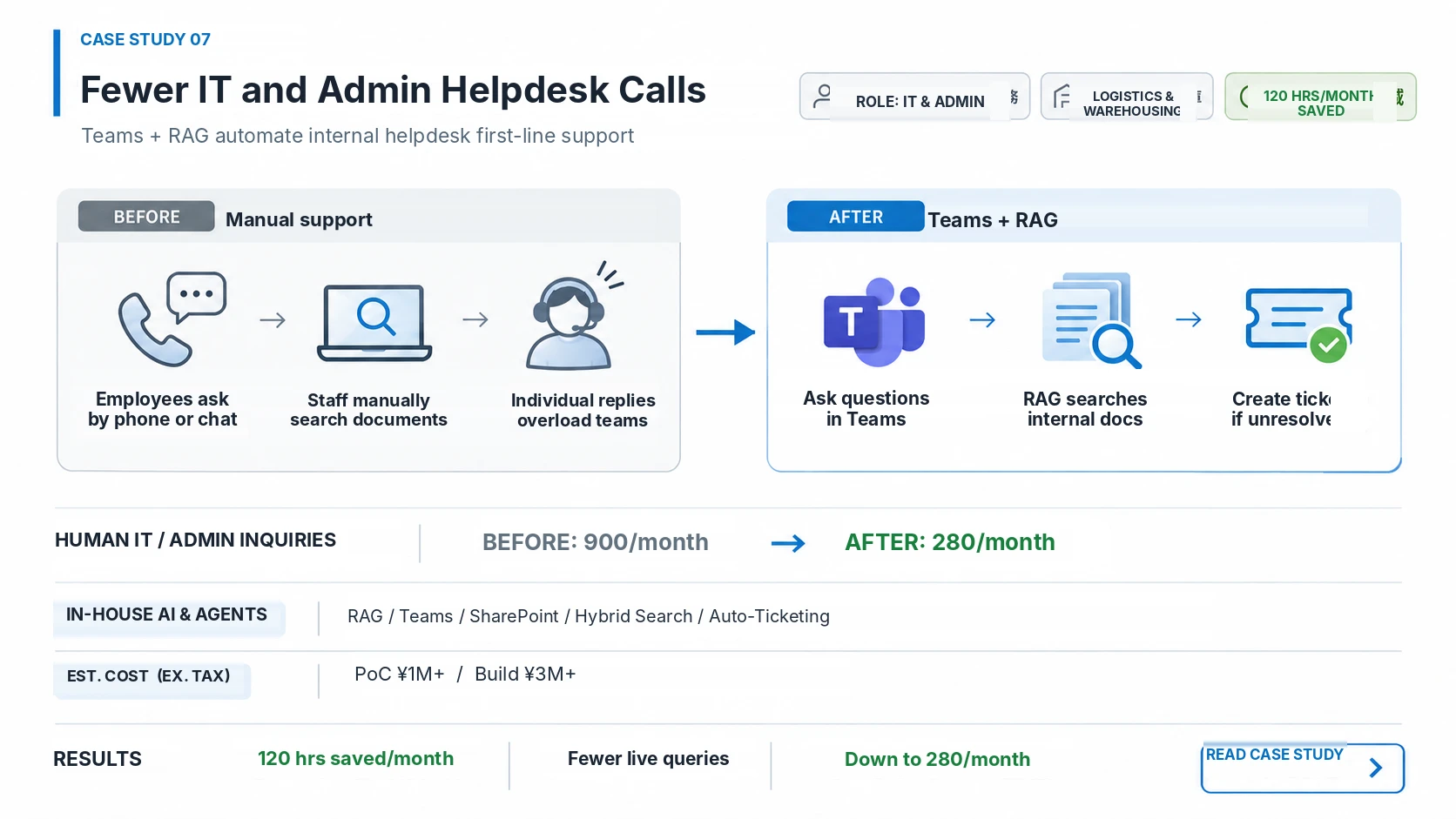
| inquiries handled by IT and General Affairs staff | About 900 a month (70% of them the same routine questions as before) | About 280 a month (about 68% resolved by AI at first contact) | Back-office support effort cut by 120 hours a month |
| Accuracy of answers and checking of sources | Guidance varied from one person to another | The policy name and page number are always shown as a link | Prevents hallucination (wrong answers) |
| Night and warehouse shift coverage | Work stopped until the next day outside business hours | Instant answers 24 hours a day, 365 days a year, from on-site tablets and smartphones | Lower risk of stoppages at logistics sites |
Challenges before the project
At the client, which operates logistics centers nationwide, about 900 internal inquiries a month were concentrated on three people in IT and four in General Affairs.
Core work stalled by the same questions over and over
Routine questions already covered in the manuals, such as being unable to connect to the VPN, how to restart a handheld terminal, or where to find the application form for bereavement and celebration leave, made up about 70% of the total.
A scenario-based chatbot introduced earlier had failed
A one-question-one-answer chatbot was introduced three years ago, but a slight change in wording returned "no match", and within a month nobody was using it.
Strong wariness about wrong answers (hallucination)
An AI giving false answers on labor rules or security procedures would cause trouble on site, so a strict design was required: answer "not stated" for anything not written in internal documents, and always show a link to the original text.
How we solved it: approach and architecture
We tackled head-on the two points where RAG projects fail most often: organizing the documents that go in, and search accuracy for manuals containing tables and figures.
Screening the documents and structuring them in pre-processing
Old pre-revision PDFs were excluded, and application procedures in table form and operating manuals with images were converted to Markdown structure and indexed.
Hybrid RAG combining vector and keyword search, with sources shown
Exact-match search for model numbers and error codes (for example ERR-402) is combined with semantic search, and a source line such as "Source: Logistics_Terminal_Manual_v3.pdf (p. 14)" is shown automatically at the end of the answer. For questions not covered, it does not guess but shows a button to escalate to IT in one click.
Designed for adoption through native Teams integration
Instead of making people learn a new web tool, employees can ask directly from the Microsoft Teams chat screen that everyone opens every day.
Workflow and system: before and after
Results after the project
AI resolves 68% of internal inquiries, and response time fell from 30 minutes to 3
Monthly support effort in IT and General Affairs fell by about 120 hours, freeing time for their real projects such as renewing the core system and strengthening security.
Instant resolution even at logistics sites running 24 hours a day
Warehouse staff on early-morning and night shifts can now check error-handling procedures on the spot without waiting for IT to arrive.
Voice from the field: “It replies with a link telling you which page of the manual to look at, so an answer can be verified in an instant and employees use it with confidence.” (Section Manager, IT Department)
System stack and environment
| Layer | Technology and configuration |
|---|---|
| Chat UI | Microsoft Teams bot (PC and on-site tablets) |
| Search and RAG engine | Hybrid search (vector search + BM25) + re-ranking |
| Document pre-processing | Parser for tables and PDF layouts + automatic incremental sync with SharePoint |
| LLM runtime | Closed cloud / private API (training opt-out guaranteed) |
| Escalation integration | Automatic summary of unresolved questions + ticket raised in the IT management list |
| Authentication and access control | Microsoft Entra ID (document access controlled by department) |


Product names and logos shown are trademarks or registered trademarks of their respective owners.
Frequently asked questions
QOur internal manuals are not organized and old files are mixed in. Can we still ask you?
Yes. In the PoC phase Seirai's PM and engineers work alongside you from taking stock of the target documents and setting priorities, so you can start without difficulty even from a disorganized state.
QCan it search correctly with our own in-house terms and specialist abbreviations?
Yes. By adding a synonym and terminology dictionary dedicated to your company on top of hybrid search, it answers accurately even questions that use in-house abbreviations or the names of old systems.
QCould our internal policy data be used to train an external model?
Never. You can choose to build in an environment with zero data retention and training opt-out via API, or in a fully on-premises local LLM environment.