

What did the AI workflow design and PMO support that cut PR and B2B article production lead time by 60% cost?
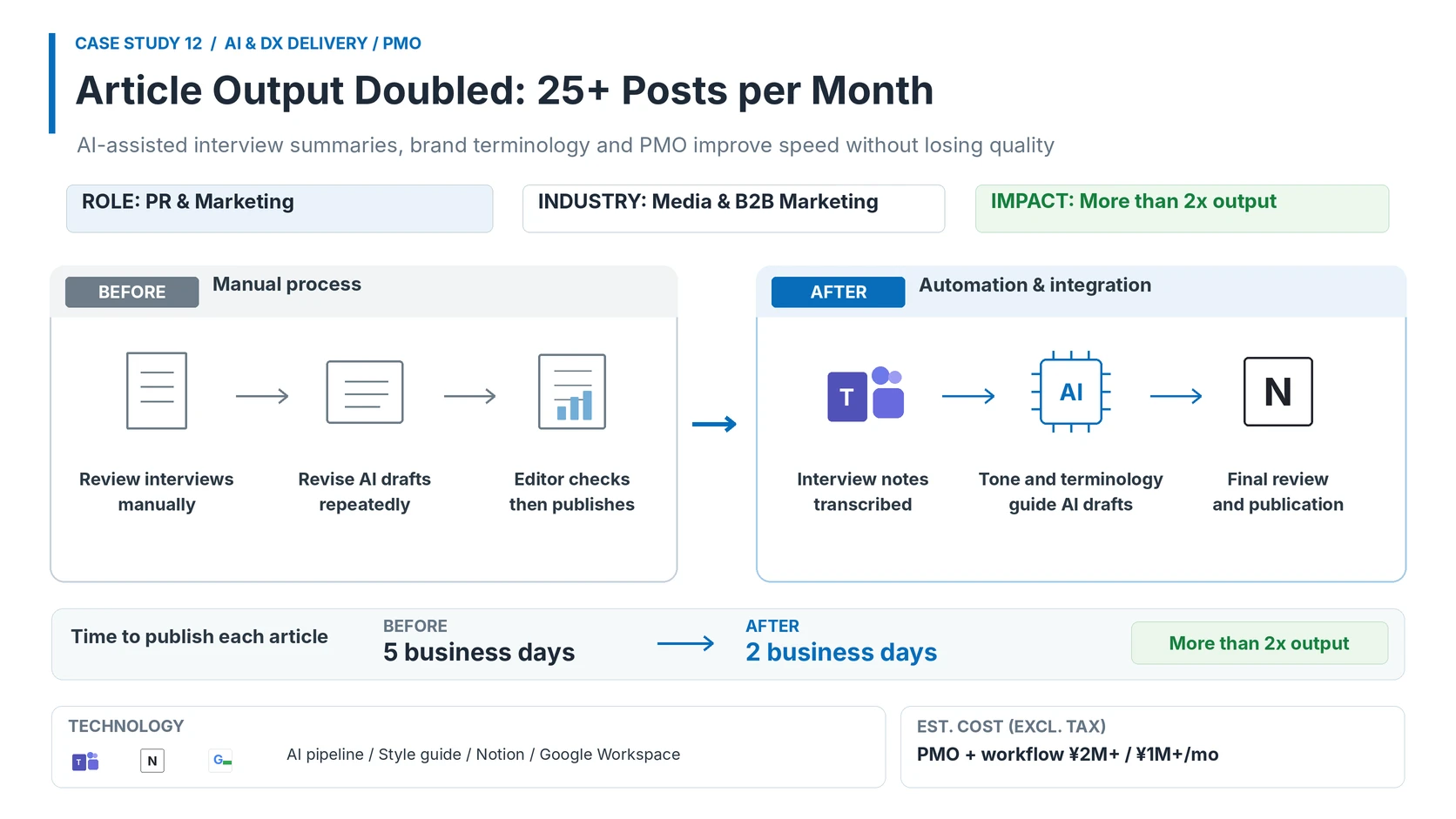
By redesigning the editorial and PR team's production process in three phases (breaking down the work, then building an AI pipeline with the company's own tone-and-style dictionary, then hands-on adoption support on the ground), the client cut production lead time per article by 60% (from 5 days to 2 on average) while removing the unnatural feel typical of AI writing. The engagement lasted 2 months. With an assumed team of 1 part-time PMO and 1 AI engineer, the work took about 2 person-months; the reference price for equivalent hands-on PMO support and workflow build is from ¥2 million (excl. tax), and ongoing support is from ¥1 million/month (excl. tax).
Before and after
| Item | Before (person-dependent production, individual ChatGPT use) | After (Seirai AI production pipeline + PMO adoption) | Impact |
|---|---|---|---|
| Production time per article | 5 business days on average (organizing the transcript + outline + writing) | 2 business days on average (outline and first draft generated the same day from the interview audio) | Production lead time cut by 60% |
| Articles and case studies published per month | 10–12 a month (the capacity limit of 3 editors) | 25 or more a month (more than double the output with the same headcount) | Faster inbound traffic and lead generation |
| Consistency of writing quality and tone | An "AI-written" feel that would not go away; style differed from writer to writer | Unified by building in the company's style rules and a dictionary of banned expressions | Editor-in-chief's correction effort cut by 70% |
| AI adoption rate within the team | Tried by only some members (under 20%) | Established as the standard flow for the whole editorial and PR team (100%) | Complete shift from individual use to organizational use |
Challenges before the project
The client was strengthening inbound marketing and wanted to publish more case studies and research articles, but the production team was running into the following walls.
Using ChatGPT individually produced only thin AI text
Pasting interview transcripts straight into generative AI brought in abstract wording and embellishments that differed from the facts, and editors ended up rewriting from scratch.
No clarity on what to leave to AI and what people should do
The tool had been introduced with the boundaries between fact-checking, reading between the lines of an interview and designing the structure still vague, and it had not taken root in the team.
Publication delayed because reviews piled up on the editor-in-chief
Structure and style rules differed from writer to writer, so the final check took time and publication took 5 business days on average.
How we solved it: approach and architecture
Rather than handing over a tool and leaving, we joined the editorial meetings as the PMO and embedded, in three phases, a production platform that secures a quality people actually want to read.
Phase 1 (breaking down the work and putting winning patterns into words)
We analyzed 30 of the company's own past articles that had performed well (generated inquiries) and set down in writing the structure templates, heading rules and banned words (the exaggerated expressions typical of AI).
Phase 2 (building a split pipeline from interview audio to outline, first draft and fact-check)
Instead of having the whole text written in one prompt, we implemented a dedicated workflow, integrated with Notion and Google Workspace, split into four stages: (1) extracting facts from the speech log (with timestamps for each quotation), (2) generating the outline, (3) a first draft with the company's tone and style applied, and (4) checking notation variants and verifying facts.
Phase 3 (weekly hands-on support and prompt improvement)
We worked alongside the team on live projects for 1 month, fine-tuning output accuracy, and prepared an operating manual that everyone on the team can use without hesitation.
Workflow and system: before and after
Results after the project
Production lead time cut by 60% and monthly output more than doubled
With faster turnaround from interview to publication, articles can now be published in good time for trade shows and new product releases.
A high read-through rate without the "written by AI" feel, and a lighter editing load
Adding a strict fact-extraction step that does not alter quoted statements reduced the editor-in-chief's correction time by about 70%.
Voice from the field: “It was not just prompt training. They came into our actual editorial flow and built, as a whole system, what should be automated and what editors should polish, and that is why everyone keeps using it.” (Editor-in-Chief, Marketing Department)
System stack and environment
| Layer | Technology and configuration |
|---|---|
| Progress management and editorial hub | Notion / Google Docs (automatic triggers linked to status) |
| Audio transcription and statement extraction | Speaker-separated transcription + fact-extraction pipeline with timestamps |
| AI generation and quality control | Multi-step LLM workflow (company style dictionary and banned-word rules built in) |
| Fact-check support | Highlighting of differences from the original interview log, automatic matching of quotations to their source |
| Delivery structure (PMO) | Three-phase hands-on support and adoption workshops by a Seirai AI & DX program PM |
| Security | Use of closed APIs (training opt-out for unpublished press releases and interview information) |
Product names and logos shown are trademarks or registered trademarks of their respective owners.
Frequently asked questions
QCan we ask for hands-on PMO support even if nobody in our company knows AI well?
Yes. In fact, working alongside companies that do not know where to start or that want AI to take root on the ground, end to end from taking stock of current work through design to adoption, is our strength.
QCan you also support AI adoption in departments other than PR and article production (HR, legal, sales planning and so on)?
Yes. We support you step by step, from a 2–4 week pilot to company-wide rollout, in line with each department's workflow.
QAfter the engagement ends, can our own members update the prompts and rules by themselves?
Yes. The style dictionary and templates are designed to be updated from a spreadsheet or Notion without an engineer, so you can run it in-house.