




How did automated checks cut the expense claim return rate from 35% to 5%, and what did it cost?
By building automatic reading of receipts with AI-OCR, and real-time checks at the time of submission against the internal travel and entertainment expense policies, into a web claim platform, the client cut the return rate on 2,400 expense claims a month from 35% to 5%. Development took 2 months in total, including a 2-week paid PoC, and the output connects directly to the import specification of the existing accounting software. With a team of 1 part-time PM and 2 engineers, main development took about 3 person-months; the reference price for an equivalent configuration is from ¥1 million for the paid PoC and from ¥3 million for the full build (both excl. tax).
Before and after
| Item | Before (Excel claims and visual checks) | After (Seirai automated checking platform) | Impact |
|---|---|---|---|
| Claim return rate | About 35% (receipt problems, wrong account codes, limits exceeded) | About 5% (caught by automatic validation before submission) | Returned claims cut by more than 85% |
| Accounting department checking effort | About 140 hours a month (overtime by 3 staff at month-end) | About 35 hours a month (visual checks only for cases flagged as exceptions) | 105 hours of work saved a month |
| Input time per claim | About 12 minutes (Excel entry + pasting receipts onto a sheet) | About 2 minutes (smartphone photo, automatic entry, submit) | Much lighter load on stores and sales staff |
| Policy violations and invoice defects | Found after settlement and checked one by one by phone or email | Automatic warning and registration-number check before the submit button is pressed | Stronger audit readiness and internal control |
Challenges before the project
About 2,400 expense claims came in every month from store staff and sales representatives at the client's roughly 60 sites nationwide, and the process built on Excel sheets and paper receipts had reached its limit.
35% of claims were returned
Amounts that did not match the receipt, missing qualified-invoice registration numbers, entertainment expenses over the per-person limit and so on; Accounting found these by eye and sent claims back by phone or email in an endless cycle.
Excel management broke down as headcount grew
Each new site brought more claimants using old Excel templates, and the three accounting staff spent a combined 140 hours a month on checking.
Off-the-shelf SaaS could not reproduce the company's own rules
Store-specific rules on out-of-pocket payments and department-specific approval routes were complex, and with general-purpose SaaS the visual check would have remained after all, which was the barrier to adoption.
How we solved it: approach and architecture
We turned the client's complex expense policies into a rule engine and built a lightweight web claim and automated checking platform that removes defects before the claimant presses the button.
Automatic receipt extraction by AI-OCR from smartphone photos and PDF uploads
The date, amount, supplier name and qualified invoice issuer number are read automatically, almost eliminating manual entry.
Real-time automatic validation against internal policies
Overlap with commuter-pass sections for transport expenses, per-person limits for entertainment expenses and missing supporting documents are checked instantly on the claim screen; when a rule is broken, the reason and guidance on how to fix it are shown.
Automatic generation of journal-entry CSV files for the existing accounting software
For approved data, department codes and account codes are mapped automatically and output as a CSV that can be imported straight into the accounting system.
Workflow and system: before and after
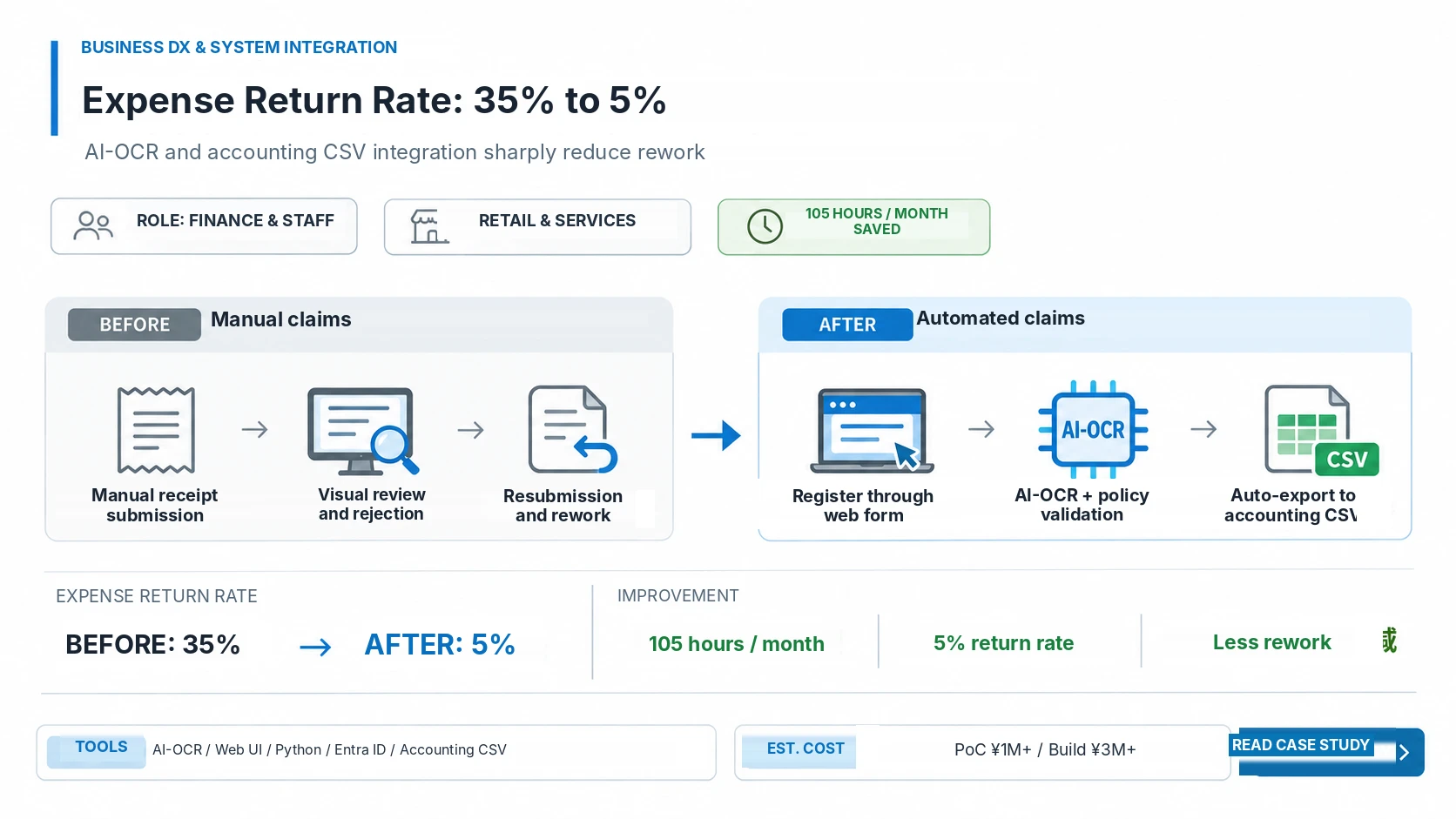
Results after the project
Return rate fell sharply from 35% to 5%
Nearly 90% of defects are resolved by alerts before submission, and unnecessary back-and-forth between Accounting and the front line has almost disappeared.
Accounting's checking effort cut by 105 hours a month
Month-end overtime fell substantially, and the monthly close was brought forward by 2 business days.
Voice from the field: “The stress of wondering whether a claim will be sent back again is gone, and I can now finish a claim on my smartphone in 2 minutes while traveling.” (Site manager, Sales Department)
System stack and environment
| Layer | Technology and configuration |
|---|---|
| Front-end claim UI | Custom web app (responsive for smartphone and PC) |
| OCR and automatic extraction | High-accuracy AI-OCR for Japanese receipts + check against the National Tax Agency invoice API |
| Policy checking platform | Python rule engine (linked to the internal travel and entertainment expense policy masters) |
| Database | PostgreSQL (central management of claim history, approval logs and receipt metadata) |
| Authentication and access control | Microsoft Entra ID (approval routes decided automatically by site and job title) |
| External integration and output | Automatic journal-entry CSV output to the existing accounting system's specification |

Product names and logos shown are trademarks or registered trademarks of their respective owners.
Frequently asked questions
QCan our company's own complex transport and entertainment expense rules be built into the automatic checks?
Yes. We build it as a rule engine in which limits and exception conditions can be set flexibly from the admin screen, so the checks can match your own policies 100%.
QCan it connect to our existing accounting software (Yayoi, Kanjo Bugyo, Money Forward, SAP and so on)?
Yes. We design the output specification to match the journal import format (CSV or API) of the accounting software you use now.
QCan we try it first in one department or at some sites?
Yes. In a 2-week paid PoC (from ¥1 million, excl. tax) we verify operation using your actual receipt data and internal policies, and you move on to company-wide rollout once the effect is confirmed.


